

Explore the Content:
- What Do People Rent the Most?
- What Can I Rent Out to Make Money?
- Most Profitable Things to Rent Out Based on Market Data
- The Easiest Things to Rent for Profit
- How to Make Money with Rentals: Step-by-Step
- Tips to Maximize Your Rental Profits
- Conclusion
- FAQs
Many individuals overlook the income potential of items they already possess. A spare room, unused vehicle, or camera equipment gathering dust could generate steady earnings. Contrary to common misconceptions, rental income isn't limited to major property developers — ordinary people can start earning from possessions right away.
This guide explores profitable rental opportunities, beginner-friendly starting points, and a straightforward approach to launching your rental income stream.
What Do People Rent the Most?
Real Estate (Homes, Apartments, Rooms)
Short-term property rentals through platforms like Airbnb have experienced significant growth as travelers seek flexible, private alternatives to traditional hotels. Remote work trends and evolving travel preferences have boosted demand, particularly for properties with reliable connectivity and dedicated workspace.
The market is expanding substantially. The worldwide short-term rental market was valued at $149.20 billion in 2025 and is projected to reach $362.41 billion by 2033, growing at approximately 11.8% annually through 2033.
Properties offer comfort without long-term commitments, while renting spare rooms provides supplementary income for homeowners. Using strategic pricing and effective administration, short-term rentals can deliver consistent revenue streams.
Vehicles (Cars, RVs, Scooters)
Vehicle rentals provide transportation flexibility without ownership burdens. Whether customers need a car for road trips, RVs for family adventures, or scooters for urban commuting, rentals satisfy diverse transportation needs.
This sector is booming. The vehicle rental industry was valued at $153 billion in 2025 and is expected to reach $278 billion by 2031, representing growth exceeding 10% annually.
Increasing personal incomes, improved airport infrastructure, and convenient online booking systems are driving this expansion. As vehicle ownership costs rise, many people choose renting for travel and daily transportation needs.
Tools & Equipment (Construction, Lawn Care)
Equipment rentals appeal to both professional contractors and DIY enthusiasts seeking cost-effective alternatives to ownership. Expensive machinery like scissor lifts, excavators, and pressure washers are ideally suited for renting since users typically need them temporarily.
Renting eliminates storage challenges and avoids substantial purchase expenses. The international construction equipment rental market was valued at $132.35 billion in 2025 and is projected to grow to $229.19 billion by 2034.
Profitable equipment rental businesses emphasize dependable assets and excellent customer support, fostering loyalty and encouraging repeat bookings.
Event & Party Supplies (Tents, Chairs, Décor)
Event rental demand remains strong as people prefer renting items like tents, chairs, and tables rather than purchasing and storing them. Evolving design trends make renting decorations attractive for hosts wanting contemporary celebrations.
Consistent year-round demand emerges, particularly during holiday periods and wedding season. Multiple items can be bundled together, generating larger transactions without increased marketing effort.
The international party supply rental market was valued at $18.65 billion in 2025 and is expected to grow to $51.91 billion by 2032, driven by increasing demand for flexible event solutions.
Electronics & Gadgets (Cameras, Drones, Phones)
Technology rentals are expanding as devices become increasingly expensive and quickly obsolete. Photographers and travelers frequently rent cameras and drones for trips and creative endeavors. Professionals and students rent phones and laptops for temporary work or educational purposes.
Renting grants access to premium equipment without substantial expenditure. The camera rental market alone was valued at $1.5 billion in 2023 and is projected to reach $2.8 billion by 2032, fueled by demand for high-quality content creation.
New gadgets with distinctive capabilities constantly emerge, making rentals a logical choice for accessing cutting-edge technology without major financial commitment.
For rental businesses, individual devices can serve multiple customers monthly, generating consistent revenue while remaining current with technology trends. Effective inventory management is essential, reducing losses and ensuring smooth customer experiences.
Fashion & Lifestyle (Designer Clothes, Handbags)
Fashion rental markets are flourishing as more consumers choose renting designer items for special occasions over purchasing them outright. This approach delivers luxury accessibility without premium pricing.
Offering a practical, environmentally responsible option for shoppers seeking high-end items for limited use creates repeat business opportunities around holidays and events. Proper cleaning enables outfits to be rented repeatedly for steady income generation.
The internet clothing rental market is expected to reach $2.8 billion by 2026 and could exceed $7.0 billion by 2036.
Fashion rental businesses make luxury accessible while building sustainable, profitable brands.
What Can I Rent Out to Make Money?

Things You Might Already Own
Beginning a rental business doesn't require substantial financial investment. Many successful operations launch with underutilized household items. Common examples include:
Spare Room or Apartment: Convert vacant space into revenue by hosting short-term guests. As flexible stays gain popularity, this represents an accessible entry point into real estate rentals.
Car or Bike: Peer-to-peer platforms enable vehicle earnings from items you own. Economy cars may generate $30–$60 daily, while bicycles and scooters appeal to urban renters seeking economical transportation.
Power Tools or Lawnmower: Homeowners and professionals frequently need temporary access to ladders, pressure washers, and mowers without ownership commitment. These items provide rapid return on investment with minimal acquisition costs.
Camera or Laptop: Students, event planners, and freelancers benefit from technology rental options. Borrowers avoid full purchase prices while equipment owners earn supplementary income.
Things Worth Investing In
For business expansion, certain items demonstrate established rental demand and attractive earning capacity:
Bounce Houses for Parties: Popular for children's celebrations, bounce houses generate significant weekend rental revenue.
Audio/Visual Equipment: Speakers, projectors, and lighting systems are frequently hired for weddings, presentations, and celebrations.
Kayaks or Jet Skis: Water recreation enthusiasts regularly rent equipment for leisure activities, particularly in coastal or lakefront locations.
Mobile Toilets or Vending Machines: These essentials for outdoor events and construction sites generate consistent income with minimal upkeep.
Starting with existing possessions and gradually acquiring popular items represents a sustainable growth strategy.
Most Profitable Things to Rent Out Based on Market Data

Short-Term Rentals (Airbnb, Vacation Homes)
Airbnb properties and vacation home rentals rank among the most recognized rental income strategies. Tourists, digital nomads, families, and business travelers often select vacation rentals over conventional hotels due to increased space, kitchen facilities, and flexible arrangements.
Many U.S. markets see earnings of $160 to $350 nightly depending on property type, geography, seasonality, and features. With regular bookings and proficient property administration, hosts frequently achieve 5–12% cash-on-cash return depending on financing, geography, and reservation rates.
Operating expenses including cleaning, property administration, utilities, platform charges, taxes, and maintenance typically represent 25–40% of gross rental income across numerous markets.
Dynamic pricing applications, improved listing photographs, and strong guest reviews help optimize occupancy and increase per-booking income. In sought-after travel or business zones, this can produce dependable long-term revenue, though actual results depend on geography and local regulations.
Vehicles (Turo, U-Haul Model, RVshare)
Vehicle rentals remain popular within the sharing economy. Vacationers, gig workers, and temporary residents favor renting vehicles instead of purchasing them, producing sustained demand for short-term transportation.
Economy vehicles typically rent for $30 to $60 daily, though peer-to-peer marketplaces frequently average $40 to $70 per day based on vehicle category, geography, and demand. Bigger vehicles like SUVs, vans, and RVs command premium rates.
RV rentals can generate $100 to $300 or more daily, subject to dimensions, seasonality, and travel patterns. A Toyota Corolla costing roughly $22,000 might earn $400 to $700 monthly following platform deductions and expenditures in numerous locations.
Platform commissions typically represent 10–40% depending on protection options, while maintenance, insurance, depreciation, and downtime constitute additional expenses. For many operators, the expense-to-income percentage ranges from 60 to 85 percent depending on availability, insurance, and depreciation.
Construction Equipment (Excavators, Scaffolding)
Construction equipment rentals represent a well-developed industry. Equipment is expensive, leading contractors to prefer temporary rental to large upfront purchases. Renting permits specialized tools for project-specific needs.
Large excavators may rent for $400 to $1,200 daily depending on dimensions, geography, and project demand. Long-term monthly rentals can generate $6,000 to $15,000 depending on machinery class and utilization. Smaller equipment like scaffolding generates $15 to $40 daily income on substantial projects.
As inventory expands, efficient asset administration becomes essential. Modern equipment rental software solutions facilitate availability monitoring, maintenance scheduling, and booking administration.
Although equipment requires continuous servicing, storage, transportation, and coverage, consistent construction demand usually ensures steady revenue. Successful fleet administration can achieve 30–50% profit margins depending on usage and maintenance costs. Heavy equipment rentals generate strong cash flow with fewer individual transactions, as each agreement produces substantial daily revenue.
Luxury Items (Watches, Jewelry, Handbags)
Luxury rentals enable customers to borrow expensive possessions for important events without ownership costs. They serve weddings, professional occasions, fashion shoots, and celebrations.
Commonly rented items encompass designer handbags, luxury timepieces, fine jewelry, and exclusive accessories. Designer bags and watches may rent for $50 to $500 daily, or participants may subscribe monthly at approximately $59 to access designer collections.
These products experience less continuous usage than certain rental assets when properly maintained, as they're typically used for specific occasions rather than daily wear.
Security deposits and thorough business insurance protect operators against harm or loss. Following insurance, platform charges, cleaning, and repairs, luxury rental enterprises can achieve 40% to 70% profit margins. Income varies based on brand reputation, coverage expenses, and harm risk.
Compact inventories generate substantial earnings while producing consistent rental income.
Tech & Electronics (Gaming PCs, Drones)
Technology rentals represent intelligent business approaches because equipment is pricey and becomes outdated rapidly. Popular rental categories feature gaming computers, professional cameras, virtual reality systems, and industrial drones. These products are expensive and constantly evolving, making short-term rentals preferable to purchases for filmmakers, creators, and engineers.
Gaming computers typically rent for $30 to $80 daily depending on performance capabilities, while professional drones range from $150 to $400 daily depending on specifications. High-end commercial drones for mapping or professional filming may reach $800 to $2,000 daily.
Renting technology for temporary projects or occasions enables service to additional monthly customers, shortening investment recovery periods. With appropriate maintenance, proprietors typically maintain 30–50% of rental earnings depending on availability and servicing requirements. As artists, filmmakers, engineers, and gaming enthusiasts persistently search for equipment, technology rentals provide attractive supplementary income.
Disclaimer: Market estimates represent general figures. Real revenue and expenditures fluctuate considerably. Conduct location-specific research and consult qualified financial professionals before investment decisions.
The Easiest Things to Rent for Profit

Furniture (on platforms like Fernish)
Furniture rentals thrive in cities experiencing frequent relocation. Students, mobile professionals, and families awaiting permanent housing frequently require temporary furnishings, ensuring consistent demand in urban centers and university communities.
Most furniture rentals operate on monthly terms. Items like couches, beds, desks, dining tables, and seating remain with renters for extended periods. For property owners, this generates predictable earnings and reduces handling frequency.
Entry barriers are minimal. Begin with owned furniture or purchase quality secondhand pieces affordably. Basic washing and upkeep allow repeated renting across numerous customers.
Furniture typically stays stationary during rental periods, resulting in gradual deterioration. This represents an accessible rental business launch option without substantial upfront costs.
Party Décor and Supplies
Party supplies offer consistent, practical rental demand. Birthday celebrations, nuptials, and gatherings occur throughout the year. Many event items serve single-use purposes, making rentals preferable to purchasing and storage.
Rentable inventory might comprise tables, chairs, tablecloths, arches, illumination, and themed ornaments. Typically, customers lease multiple pieces per celebration, naturally expanding transaction amounts.
Demand intensifies on weekends and throughout busy event periods. Limited inventories manage consistent bookings when properly maintained and prepared for delivery.
Between occasions, primary responsibilities involve storage and sanitation. Conscientious care allows décor pieces to serve dozens of events. Party supply rentals provide accessible business launches requiring modest initial capital.
Camping Gear
Camping equipment rentals serve outdoors enthusiasts and travelers. Many individuals enjoy periodic park, beach, and hiking expeditions but resist purchasing equipment for occasional use. Rentals deliver adventure without continuous expenses or storage challenges.
Available equipment might include tents, sleeping bags, camping apparatus, backpacks, and portable refrigeration. Rentals typically serve brief trips with rapid returns, enabling multiple monthly customer transactions.
Demand typically rises seasonally and during holiday breaks. Modest gear collections generate consistent bookings throughout favorable seasons.
Camping items are transportable and storable. Regular washing, drying, and inspections maintain readiness for subsequent customers. Camping gear rentals suit home-based or limited local operations.
Baby Items (Cribs, Car Seats)
Baby equipment rentals address traveling family requirements. Parents frequently avoid transporting bulky items like cribs, strollers, and car seats during visits or vacations. Rentals offer practical solutions.
Families access sanitary, maintained gear upon landing and return it at departure. Services prove particularly beneficial in popular vacation zones and frequently visited destinations.
Trust proves essential here. Parents expect offered equipment to be hygienic, properly serviced, and appropriate for children. Operators build confidence through rigorous sanitation practices and thorough maintenance reviews prior to each rental.
Numerous rentals extend multiple days or weeks, decreasing handling requirements. Appropriate maintenance preserves equipment functionality across extended periods. Baby equipment rentals help families while supporting rental operations.
Pet Supplies or Pet Boarding Space
Pet-related rentals serve necessary owner needs. During travel or demanding schedules, pet owners frequently lease required items instead of purchasing occasional-use products.
Potential offerings encompass carriers, kennels, and feeding systems for temporary rentals. Some enterprises supply temporary lodging areas for pet supervision throughout owner absences.
Extra residential space might accommodate temporary animal care through room, garage, or fenced area modifications for secure short-term environments. Consistent attention and routines ensure animal comfort throughout stays.
Pet owners frequently return to trusted services. Established relationships encourage repeat reservations. Straightforward equipment and dependable care create expandable pet rental operations supporting local pet owners.
Pro Tip: Commence modestly, reinvest revenues, and expand systematically.
How to Make Money with Rentals: Step-by-Step
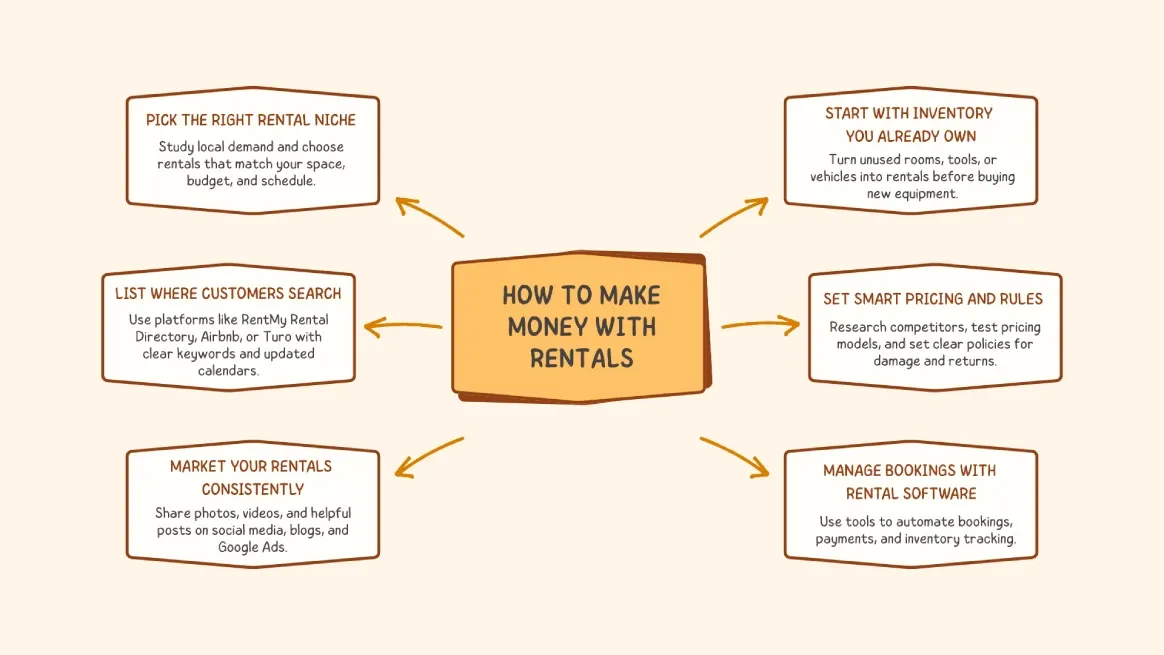
Step 1: Pick Your Niche
Before choosing rental items, comprehend local requirements and personal capabilities. Optimal niches intersect market demand with practical manageability.
Start by identifying prevalent local rental patterns. Tourism destinations may favor vehicle rentals, while developing neighborhoods may prefer equipment or machinery. Examine pricing, booking frequency, and standard rental lengths to identify authentic demand patterns rather than assumptions.
Personal circumstances matter significantly. Limited storage capacity makes managing smaller electronics or clothing pieces simpler than oversized furniture or heavy machinery.
Aligning niches with market requirements and individual routines promotes consistency and prevents exhaustion while establishing steady rental income. Once niche selection clarifies, beginning the actual renting procedure comes next.
Step 2: Source or List Your Inventory
The simplest approach involves recognizing presently owned assets. Unoccupied rooms, automobiles, devices, or machinery frequently become opening rental products without requiring financial outlay.
Compile what you possess and assess market reception prior to acquiring additional inventory. Rapid booking reception signals authentic demand, supporting inventory expansion considerations.
When purchasing new items, prioritize durable products withstanding repeated use without regular maintenance. Budget-conscious proprietors acquire excellent-condition secondhand inventory. Protective covers, containers, or storage systems expand equipment lifespan.
Beginning modest and leveraging existing resources transforms everyday belongings into income-generating properties without substantial financial exposure. Once inventory preparations finish, customer visibility becomes essential.
Step 3: Choose Where to List
Creating accessible rental discovery follows inventory preparation. Appropriate distribution channels accelerate customer connection and booking calendar population.
List on Rental Platforms for Fast Visibility
Rental marketplaces like RentMy Rental Directory, Turo, and Airbnb offer immediate advantages because they maintain audiences and furnish booking mechanisms, payment options, and interaction tools. Platform charges offset rapid exposure and credibility advantages.
When listing, compose persuasive descriptions containing appropriate language attracting customers. Maintain current details, prices, and visuals for improved visibility. Precise availability updates prevent simultaneous reservations; specialized software assists with multiplatform coordination.
Google Business Profiles increase visibility further, appearing in nearby searches and maps while establishing credibility with prospective customers.
Build Your Own Rental Website for Direct Bookings
As enterprises expand, independent websites strengthen branding and facilitate unmediated bookings. Platforms like RentMy simplify website development, delivering prepared, search-optimized platforms with reservation systems, transaction processing, and matching aesthetics. No technical expertise necessary.
Self-directed booking websites grant greater authority and profit, eliminating commission deductions. Since approximately 60% of worldwide internet participants access through smartphones, guarantee mobile optimization, quickness, and accessibility.
Employ professional images, genuine testimonials, and straightforward pricing for customer attraction. Incorporating neighborhood search terminology helps customers discover rental operations and optimize website search positioning.
Step 4: Set Pricing, Rules, and Availability
Intelligent rates and explicit regulations drive enterprise development. Appropriate pricing sustains bookings, while poor approaches damage profitability.
Investigate neighborhood competition for baseline rate establishment. Trial multiple approaches to identify optimal strategies. Hourly costs suit temporary uses, while daily maximums create foreseeable expenses building customer trust.
Implement collection costs for multi-item arrangements or reduce prices for lengthy bookings. If collaborating with partners, incorporate their compensation into pricing.
Explicit regulations regarding deterioration, postponed departures, and protective deposits prevent disagreements. Refresh availability regularly and permit adaptable rental intervals. Continuous pricing modifications considering reservation information increase earnings and consumer contentment.
Step 5: Market Your Rental Offering
Successful marketing communicates rental value clearly. Emphasize how offerings address customer requirements.
Begin with excellent photographs and video demonstrations displaying practical applications. Customers mentally participate in ownership. Focus promotional material on advantages instead of specifications.
Social channels reach broad populations, with above 5.66 billion individuals participating. Distributing brief clips and customer accounts establish confidence.
Immediate exposure arrives through Google Ads targeting residents actively seeking rental services. Create informative resources and manuals enhancing long-term search rankings.
Email marketing sustains customer relationships. This extremely productive approach generated approximately $9.5 billion in 2024, driving recurring reservations through promotional messaging and inventory announcements.
Step 6: Manage Bookings, Payments, and Returns
Connecting bookings, finances, stock, and interaction through proper mechanisms makes handling numerous rentals straightforward and expandable.
Systematic approaches streamline operations for proprietors and customers. Centralized calendars and computerized transactions stop forgotten reservations and save effort. Equipment checklists before and following rental verify condition, speed turnaround, and encourage favorable evaluations.
Growing demand enables outsourcing duties like sanitation, defending individual schedules. Specialized administration systems including RentMy consolidate schedules, processing, and stock administration, eliminating simultaneous bookings and maintaining customer communication.
Tips to Maximize Your Rental Profits
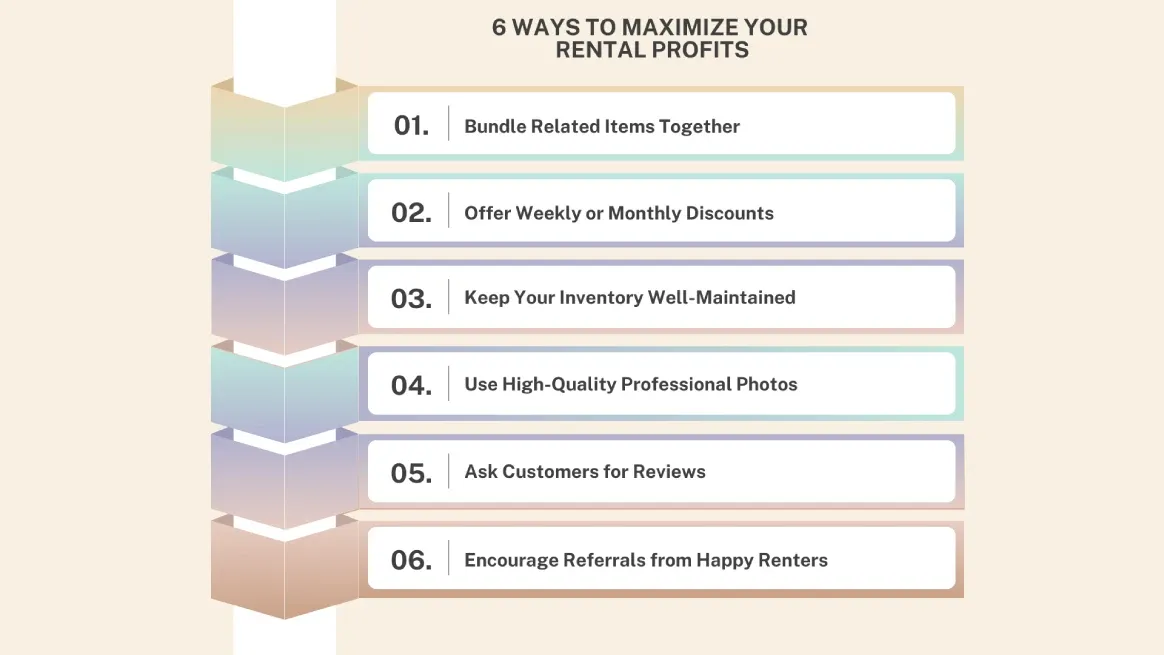
Increasing earnings doesn't always require extra purchases. Modest operational improvements regularly boost earnings.
Combining connected items increases consumer selection simplicity and order totals. Including tent plus furniture plus illumination packages represents this approach. Packages decrease customer decision difficulty while naturally expanding total transaction amounts.
Offering reduced weekly or monthly pricing encourages longer arrangements. Extended bookings maintain inventory circulation throughout reduced periods while decreasing pickup and return handling.
Sustained inventory condition proves important. Consistent sanitation, minimal repairs, and equipment documentation extend lifespan and improve customer interactions.
Professional-quality photographs build confidence and improve listing appearance. Requesting customer evaluations and referrals enhances trustworthiness, frequently attracting fresh bookings without marketing spending.
Conclusion
This resource examines approaches to rental income generation, beginner-friendly entries, and fundamental procedures for transforming everyday items into income sources.
Recognizing monetary possibilities within existing possessions proves most important. Unoccupied bedrooms, unnecessary vehicles, or supplementary furniture could generate earnings with minimal effort.
Gradual beginnings work optimally. Experiment with individual concepts, develop experience, and progress forward. With dedication, rental operations become dependable supplementary earnings.
Start earning from what you already own. Get started free with RentMy — try up to 5 orders free, no credit card required.
FAQs
What Is The 50% Rule in Rental Property?
The 50% rule approximates rental property functioning expenses. It estimates roughly fifty percent of earnings covers expenditures including servicing, governmental charges, protection, and administration. Loan obligations typically remain separate. Business proprietors employ this calculation for preliminary profitability estimation.
What Is The Most Profitable Thing To Rent?
Vacation rental properties, construction equipment, and automobiles typically produce maximum profit. These resources produce strong earnings and sustained customer demand. Actual revenue relies upon availability, servicing expenses, and neighborhood conditions.
What Is The 70% Rule in House Flipping?
The 70% principle directs purchasers when obtaining properties for renovation. It recommends paying maximum 70% of the property's corrected appraisal minus restoration expenditures. The formula: Maximum Offer = (ARV × 0.70) – Repair Costs.
What Is The 3-3-3 Rule In Real Estate?
Certain investors employ the 3-3-3 principle as moderate growth guidance. It suggests possessing three earnings-producing properties within thirty-six months. Different understandings may concern 3% earnings, 3% vacancy allowance, and ninety-day reserves.
Is Renting Out Personal Items Safe?
With appropriate protections, individual item rentals prove manageable. Security payments, binding contracts, individual recognition, and coverage reduce hazards. Several platforms incorporate safeguards and disagreement resolution.
How Do You Protect Rental Items From Damage?
Defense commences with explicit arrangements and protective deposits. Pre and post-rental documentation and photographs generate beneficial records. Many proprietors implement coverage options or system safeguards managing unexpected deterioration.