


You’ve got the containers and customers, but your revenue isn’t where it should be. So, what are the proven ways to boost your container rental revenue that actually work?
The good news is, the portable storage rental market is booming, set to jump from $8.6 billion in 2025 to $16.2 billion by 2034. While demand is growing, not everyone is seeing the benefits.
That’s where this guide comes in! We’ll share practical tips to improve your pricing, get more bookings, and make every rental count. Let’s get started on the strategies that will make a real difference.
Container Rental Profitability Calculator
Calculate fleet revenue, logistics fees, and maintenance.
Fleet & Rental Rates
Logistics & Add-ons
Container Rental Landscape in 2026: Trends and Opportunities

The container rental market has become essential for modern logistics, construction, and storage. Once a small service, it is now a major industry.
The global portable storage container rental market, valued at $8.6 billion in 2025, is projected to reach $16.2 billion by 2034, growing at 7.3% annually. This growth is driven by several key factors.
First, the rise of e-commerce requires storage near delivery hubs. Portable containers offer a flexible alternative to warehouses.
Construction firms need them, too. For keeping tools and materials secure on-site.
More businesses are using flexible supply chains these days. This creates a need for specialized units like refrigerated containers and mobile offices.
Urbanization contributes to demand. Space constraints push businesses toward compact, movable storage.
Short-term and seasonal storage needs are increasing as well, especially for events, retail peaks, and temporary projects.
Together, all these trends are helping the container rental market’s steady expansion.
Why Most Container Rental Businesses Struggle to Scale Revenue
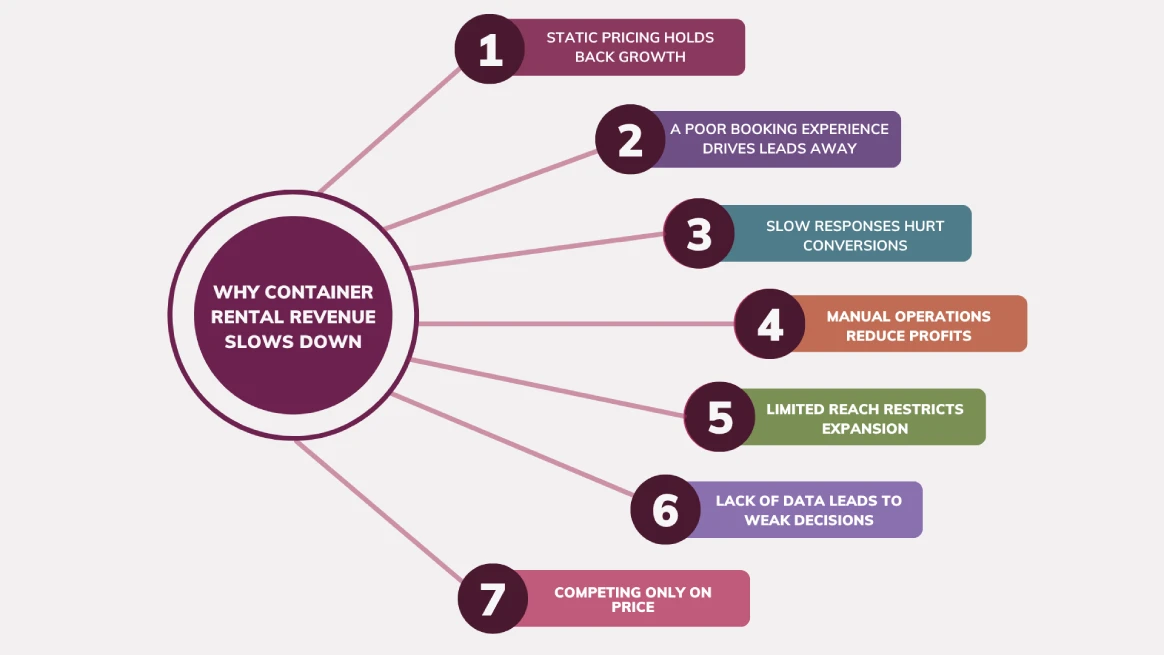
For many container rental businesses, demand is not the problem. Revenue is. And the reasons are rarely dramatic. They are small frictions, accumulating over time.
One common issue is static pricing. Many businesses set fixed rates and rarely adjust them. This approach ignores demand, seasonality, and competition.
A poor customer experience, complicated booking, slow responses, all drives clients away before a price is even quoted.
Operational inefficiencies like manual billing and poor inventory tracking quietly eat away profits, while geographic limits and inconsistent fleet quality put a hard ceiling on growth.
Many of these businesses often operate without data, guessing at what the market wants instead of knowing. They rely on outdated marketing, struggle with cash flow, and offer rigid contracts in a market that values flexibility.
When every provider looks the same, the only lever left is price. The result is a business that runs in place. It works, but it does not grow.
7 Proven Strategies to Increase Container Rental Revenue
Ready to grow your rental revenue? These simple, proven strategies focus on pricing, positioning, and customer needs. Implement these smart changes to keep your rental business profitable and earn more from your existing inventory, without adding unnecessary complexity.
Strategy 1: Create a Smarter Pricing and Revenue Strategy

Pricing is the fastest way to boost revenue, but many businesses set it and forget it. A smarter approach helps you stay competitive and protect your margins. When your price rental rates reflect real-time demand and customer type, you stop leaving money on the table.
Implement Dynamic Pricing Based on Demand
Dynamic pricing means changing your rental rates based on demand, timing, and availability.
During peak seasons, you can increase prices to maximize revenue. In slower periods, offering slight discounts keeps your containers booked and generates income.
This strategy keeps your revenue steady and your inventory balanced without you having to constantly change things. Customers are already used to prices changing in other industries, so as long as you’re clear about it, this method will feel normal to them.
To use dynamic pricing well, start by tracking booking trends and seasonal patterns. Figure out when demand is high and when it’s low, and set your prices to match. Small price changes can boost your overall revenue without costing you more.
Analyze Market Trends and Competitor Rates
Your pricing should never exist in isolation. To stay competitive, you must analyze market trends and competitor rates. This isn’t about being the cheapest; it’s about offering the best value for your price.
Part of your business analysis process should involve regularly reviewing what your competitors are charging and how market demand is shifting. This allows you to adjust your rates strategically.
You can use simple tracking methods or software to monitor pricing trends. This will help you understand your position in the market, price your services with confidence, and avoid losing customers.
Create Tiered Pricing for Different Customer Segments
Not all customers have the same needs or budget. A construction company renting multiple units long-term has different expectations than a small business needing one container for a short period. Tiered pricing helps you serve both segments effectively.
By offering different pricing levels, you give customers options. For example, you can provide bulk discounts for long-term rentals or premium rates for high-demand usage.
This flexibility also improves conversion rates. Customers feel they are choosing a plan that fits their situation instead of being forced into one rigid price.
Over time, this attracts a wider range of clients and increases your average revenue per customer.
Use Automation for Real-Time Price Adjustments
Keeping track of pricing manually can be a huge task, especially as your business expands. Automation solves this by adjusting your prices automatically based on rules you create, like demand levels, availability, or booking timelines.
This means your prices can change instantly to match market conditions. This helps you to make more money without having to watch things all the time. It also cuts down on mistakes from manual updates.
Modern rental software such as RentMy can manage these price changes for you and ensure customers always see clear and current pricing. This not only makes things smoother for them but also helps you earn more consistently.
Strategy 2: Expand Your Offerings to Capture More Market Segments

Don’t limit your growth to just one type of container. Branching out is the key to unlocking new revenue streams and helping you increase your rental bookings. Serving more industries with varied containers attracts a wider range of customers and gives them more reasons to choose you.
Introduce Specialized Containers (Reefer, Office, Event Units)
Standard storage containers are useful, but offering specialized containers significantly boost your returns. These units, such as refrigerated (reefer) containers for food or medical supplies, office containers for on-site teams, and event units for temporary festival or pop-up setups, solve specific problems for clients.
As they offer targeted convenience and functionality, you can charge premium rates for these specialized units. Customers are often willing to pay more for a solution that perfectly fits their needs.
Adding these unique options to your inventory helps you stand out in a crowded market. Instead of competing on price alone, you can compete on the value and capability you provide. This strategy can lead to better profit margins and stronger, long-term customer relationships.
Target New Industries (Construction, Events, Retail, Agriculture)
While many businesses focus solely on construction, other industries like events, retail, and agriculture also need flexible storage containers. By not targeting these segments, you could be missing out.
Retailers use containers for seasonal stock. Farmers need storage during harvest periods. Event organizers rely on temporary setups for short durations. Each segment brings its own demand patterns and pricing opportunities.
Expanding to more industries means you’re not relying on a single revenue source. When one area is slow, another might be busy. This creates a more stable income over time.
Offer Flexible Rental Durations (Short-Term & Long-Term)
Flexibility is a strong selling point. Some customers need a container for a few days, while others need it for months or even years. Offering both short-term and long-term options helps you capture a wider range of demand.
Short-term rentals often come with higher daily rates, which can boost revenue quickly. Long-term rentals provide stability and predictable income. A balanced mix of both creates a healthier revenue model.
Make your terms clear and easy to understand. Customers should know exactly what they are paying for and how long they can keep the container. This clarity builds trust and reduces hesitation during the booking process.
Customize Solutions for Unique Customer Needs
Every customer situation is a little different. Some may need shelving inside the container. Others may want branding, lighting, or security upgrades. Offering simple customization options helps you meet these needs without overcomplicating your operations.
When you customize, customers see more value in what you offer. They feel like they’re getting a special solution, not just a standard box. This often leads to customers being willing to pay more.
Begin with popular add-ons and then add more as you see what customers are asking for. These custom options can become a strong revenue driver and will help you stand out from the competition.
Strategy 3: Increase Revenue with Upselling & Cross-Selling

One of the biggest mistakes hurting rental business profits is not making each booking more valuable. Upselling and cross-selling can help, as long as the options you offer genuinely improve the customer’s experience.
Offer High-Value Add-Ons That Customers Actually Need
A storage container is just the start. Many customers need more to get the most out of their rental. By offering high-value add-ons, you can solve their problems and boost your revenue.
Essential services like delivery, pickup, security locks, and shelving make the container more convenient and useful. For sensitive items, GPS tracking provides extra security.
Offering these extras increases your revenue per order and improves customer satisfaction by providing a one-stop solution.
When you clearly offer these add-ons, customers are often happy to pay for the convenience. Focus on simple, relevant extras that customers ask for. Over time, these add-ons can become a steady source of income and make your main service more appealing.
Time Your Upsells at the Right Moments
Timing plays a big role in whether an upsell works or gets ignored. The best moment is during the booking process when customers are already making decisions and are more open to adding useful extras.
Another good time to upsell is when a customer asks to extend their rental. Their needs might have changed, making it a great moment to offer upgrades or other services.
Bundled packages are another effective method. By grouping related services together at a lower price, you can make the deal more attractive. This encourages customers to choose more services without feeling pressured.
Use Customer Data to Personalize Recommendations
Not all customers need the same add-ons. That’s why using customer data to personalize recommendations is so important.
By analyzing past bookings, rental duration, and usage patterns, you can suggest add-ons that genuinely fit each customer’s needs instead of just offering generic upgrades.
For example, a long-term storage client might need climate control, while a short-term event renter might prefer quick delivery and setup. Tailoring your suggestions shows that you understand your customers’ needs, which builds trust and boosts revenue.
Strategy 4: Optimize Customer Experience for Higher Conversions

Getting traffic is one thing, turning visitors into paying customers is another. If your booking process is slow or confusing, you’ll lose business. A smooth, effortless experience builds trust and makes customers more likely to complete their booking.
Build a Mobile-Friendly, Easy-to-Use Website
With over 60% of people browsing on their phones, your website must be mobile-friendly. If your website does not load well or feels hard to navigate on mobile, potential customers will leave before even checking your pricing.
A clean layout, fast loading speed, and simple structure make a big difference in web design. Visitors should quickly understand what you offer, how much it costs, and how to book. Confusion at this stage often leads to lost opportunities.
Focus on clarity over design complexity. Keep menus simple, highlight key actions, and make contact options easy to find. A smooth mobile experience alone can greatly improve your conversion rate without increasing your marketing spend.
If you don’t have time to build a website, platforms like RentMy offer ready-made, mobile-friendly rental sites with built-in booking and payment tools, helping you get direct bookings without any technical stress.
Turn visitors into bookings with a fast, simple website built for rentals
- Free 14-day trial
- No credit card required
Simplify Booking with Instant Quotes and Clear Pricing
Customers want quick answers. If they have to wait for a quote or dig through unclear pricing, they will likely move on to another provider. Instant quotes remove that friction and help customers make decisions faster.
Clear pricing also builds trust. Show what is included, what costs extra, and avoid hidden fees. When customers feel confident about what they are paying, they are more likely to complete the booking.
Keep the booking steps short and direct. The fewer clicks it takes to confirm a rental, the better. A simple and transparent process reduces hesitation and turns more visitors into paying customers.
Reduce Friction and Support Customers at Every Step
Even small issues can prevent a booking. Long forms, confusing instructions, or slow pages can frustrate customers and make them leave. By reducing friction, you make it easier for people to book your container rental.
Guide your customers with strong calls-to-action. Buttons like “Get a Quote” or “Book Now” should be clear and easy to follow. With clear navigation, your customers will always know what to do next without having to second-guess.
Your customer support also plays a key role. Make sure you can answer questions quickly through chat, phone, or email. When you offer fast and helpful support, customers are more likely to book with confidence.
Strategy 5: Build Customer Loyalty & Recurring Revenue Streams

It costs five to 25 times more to get a new customer than to keep an old one. Focusing on keeping your current customers is more profitable. It creates steady income, which helps your business plan and grow.
Create Loyalty Programs with Rewards and Discounts
Loyalty programs encourage repeat business. Simple rewards, like discounts or credits, make them feel valued and build stronger relationships.
These programs don’t need to be complicated; even small, easy-to-understand perks create a sense of value and encourage repeat business.
Keep your rewards easy to understand and easy to redeem. When customers clearly see the benefit, they are more likely to stick with your service instead of exploring other options in the market.
Introduce Subscription-Based Rental Models
Want more predictable revenue? Try a subscription-based rental model.
Instead of relying on one-off bookings, you can have customers pay a recurring fee for continuous container access. This is great for businesses that need ongoing storage or have rotating project needs.
For your customers, subscriptions mean they don’t have to book over and over again. They get consistent access for a predictable price.
For you, it means a steady income, making it easier to manage your inventory and plan ahead.
Start with simple plans based on how long or how often a customer rents. As you figure out what your customers want, you can adjust your offerings.
Over time, subscriptions can become a great source of steady cash flow and help you build strong relationships with your customers.
Offer Incentives for Repeat and Long-Term Customers
Your long-term and repeat customers are valuable. Why not reward them? Offering incentives like discounted rates for longer rentals or special prices for repeat bookings encourages them to stick with you.
This helps you build a loyal customer base you can rely on, instead of always searching for new clients.
Make sure these special offers are easy to find. When customers see the extra value in renting from you long-term, they’ll be more likely to come back.
Personalize Engagement Using Customer Insights
Every customer interaction gives you useful information. By tracking booking history, rental duration, and preferences, you can create more relevant and timely communication. This makes your service feel more personal and less generic.
For example, you can remind customers when they might need a container again or suggest services based on past usage. These small touches show that you understand their needs and are ready to help.
Personalized service builds trust. When customers feel understood, they are more likely to come back and recommend your business to others. This leads to more repeat business.
Strategy 6: Drive Demand with Digital Marketing & Partnerships

Even with the best service, your business won’t get far if customers can’t find you. A solid marketing plan helps you reach the right people at the right time. It helps create a steady stream of interested customers.
Invest in SEO, Paid Ads, and Local Search Visibility
Most customers start their search online. If your business does not appear when they look for container rentals, you miss out on valuable opportunities. Search engine optimization helps your website rank higher for relevant queries.
Paid ads can bring faster results, especially for high-intent searches. Local search visibility is just as important, as many customers look for nearby providers they can trust and access quickly.
Focus on clear keywords, strong landing pages, and accurate business information. When your business is easy to find and understand online, more visitors turn into actual bookings.
For faster growth, RentMy Marketing Services can manage your SEO, paid ads, and conversion-focused campaigns, optimized specifically for container rental businesses.
Use Content Marketing (Videos, Case Studies, Testimonials)
Content helps customers understand what you offer and why it matters. Videos can show how your containers are used. Case studies highlight real results, while testimonials build trust by sharing customer experiences.
This type of content answers questions before customers even ask them. It also reduces uncertainty, which often delays booking decisions. When people see proof and clear examples, they feel more confident moving forward.
Keep your content simple and focused on real use cases. Over time, this builds credibility and attracts customers who are already interested in your services.
Optimize Listings on Google and Business Directories
Your online listings on platforms like Google are your digital storefronts and often the first place customers look. If this information is outdated or incomplete, it can hurt your chances of being chosen.
An optimized Google Business Profile is essential, as it helps you appear on Google Maps where customers search for directions, reviews, and contact details.
To build trust and improve visibility, ensure your business name, contact information, and service descriptions are consistent across all platforms. You should also add photos and encourage satisfied customers to leave reviews, as positive feedback builds credibility quickly.
An optimized listing improves visibility and credibility at the same time. When customers find clear and reliable information, they are more likely to reach out or book directly.
Build Partnerships with Construction Firms and Event Planners
Building partnerships with construction firms and event planners can bring you a steady stream of customers without a lot of marketing effort. Construction firms need containers for their projects, and event planners need them for temporary events.
By working with them, you can become their go-to container provider. This means less time spent searching for new customers and more repeat business as they start new projects.
To build strong partnerships, always be reliable and communicate clearly. When you deliver on time and meet their needs, they’ll be more likely to recommend you to others in their network.
Strategy 7: Simplify Operations with Technology & Data

As your rental business grows, manual management can slow you down. Little mistakes add up, costing you money and leaving customers unhappy. Technology can help by automate tasks, reduce mistakes, and making smarter decisions.
Automate Billing and Recurring Payments
Manual billing can quickly become a real pain. When you’re managing several rentals with different timelines and prices, it’s easy to make mistakes. Sending invoices late or missing payments can disrupt your cash flow and waste time on follow-ups.
Automated systems can take care of invoices, reminders, and recurring payments for you. This means customers get their bills on time and payments are handled smoothly, which helps keep your income steady.
It also improves the customer experience. Clients prefer predictable and hassle-free billing, especially for long-term rentals. When payments feel simple and transparent, customers are more likely to continue using your service without hesitation or confusion.
Track Inventory in Real Time to Maximize Utilization
Knowing where your containers are and how they’re being used is important for maximizing revenue. Without real-time tracking, it’s easy to lose track of them, which can lead to containers sitting empty or you missing out on rental opportunities.
With proper tracking systems, you can see availability, location, and usage at a glance. This helps you move containers where demand is highest instead of letting them sit unused in low-demand areas.
Better visibility also leads to smarter decisions. You can plan rentals more effectively, avoid overbooking, and ensure that every container is working as hard as possible to generate income for your business.
Use Data Analytics for Demand Forecasting
Guessing can hold you back. Data analytics shows you when demand will likely go up, so you can get ready beforehand.
By analyzing past bookings, seasonal trends, and customer behavior, you can forecast demand more accurately. This allows you to adjust pricing, allocate inventory, and plan marketing efforts with better timing.
Over time, these insights become a strong advantage. You reduce downtime, avoid missed opportunities, and make decisions based on real patterns rather than assumptions. This leads to more consistent revenue and better overall performance.
Optimize Delivery, Routing, and Maintenance
Delivery and logistics can really eat into your profits. Bad routes or messy schedules mean wasted fuel, delivery delays, and unhappy customers.
You can save a lot of time and money if you optimize delivery routes. By planning smarter, you can get more deliveries done without extra stress. Plus, when you know where your containers are and how they’re being used, scheduling maintenance becomes easy.
Keeping your containers in good shape means they last longer and work better, which is great for your bottom line. And when your deliveries are on time and your equipment is reliable, customers will trust you and keep coming back.
Supercharge Your Revenue with the Right Rental Management Software
Running a container rental business involves balancing bookings, payments, and inventory, which can slow your growth. An effective system organizes your work and removes friction, letting you focus on revenue.
That’s where RentMy’s Subscription Rental Software comes in. It centralizes your operations, automating billing to ensure steady cash flow and providing real-time inventory tracking to maximize fleet usage. You’ll always know which containers are available, preventing missed opportunities.
The software also boosts revenue by suggesting relevant add-ons during booking, increasing order value effortlessly. Customers enjoy a smoother, clearer rental process, encouraging repeat business.
Behind the scenes, you gain valuable insights into performance and demand, helping you make smarter, data-driven decisions.
As your business grows, RentMy keeps your operations simplified, allowing you to scale with confidence.
Increase revenue with smarter tools that work in the background.
- Free 14-day trial
- No credit card required
Conclusion
And that’s a wrap! We’ve explored several practical ways to boost your container rental revenue. By focusing on pricing, customer loyalty, and technology, you can build a stronger, more reliable income stream.
It’s all about finding the right balance. When your pricing, customer experience, and operations work together, you’ll see more bookings and happier customers, all without the extra stress.
Ready to get started? Even a small change today can make a big difference. Keep testing, keep improving, and watch your business grow.
FAQs
Focus on four simple actions. Bring in more customers, increase the value of each booking, encourage repeat rentals, and adjust pricing based on demand. Small improvements in these areas work together, helping you grow revenue steadily without needing major changes or added complexity.
You can earn by renting containers for storage, construction, or business use. Income can increase by offering modified units like offices or refrigerated containers. Some operators also benefit from relocating containers between high-demand areas and adding services that improve customer value.
Rental prices usually range from $100 to $400 per month, depending on location, condition, and rental duration. Short-term rentals or premium units may cost more. Additional charges like delivery, pickup, and optional add-ons can increase the total cost for customers.
Standard dry storage containers are the most common due to their versatility. Refrigerated containers, office units, and modified containers are also in demand, especially for specialized use cases that require extra features or controlled environments.
Key costs include container purchase, maintenance, transportation, storage space, and insurance. Operational expenses like staffing, marketing, and software also add up, so managing these carefully is important for maintaining strong profit margins.